
An aid deployment can shift in minutes. A routine road move turns into a hostile checkpoint. A crowd outside a distribution point changes mood. A team member is injured when evacuation is delayed, communications are weak, and local support is limited. In those moments, Hostile Environment Training for aid workers stops being a compliance item and becomes a professional necessity.
For humanitarian staff, the risk picture is broader than active conflict. It includes civil unrest, criminal violence, kidnapping, vehicle incidents, drone threats, medical emergencies in austere settings, and the cumulative pressure of working under sustained stress. Good intentions do not reduce those risks. Preparation does.
What hostile environment training for aid workers is really for
The purpose of this training is not to turn humanitarians into security specialists. It is to help them work more safely, think more clearly under pressure, and make better decisions when conditions deteriorate. That distinction matters.
Aid organizations need staff who can recognize danger early, avoid preventable exposure, and respond in a structured way when an incident unfolds. The best courses focus on practical judgment. Participants learn how to read an environment, assess movement plans, manage their profile, react to unrest, and support themselves and others until help arrives.
That makes this training relevant well beyond war zones. Many serious incidents happen in places that sit below the threshold of open conflict. Elections, protests, banditry, weak infrastructure, and fragmented local authority can create highly unstable operating conditions. Field teams often enter these environments with tight timelines and incomplete information. Training helps close that gap.
Why aid workers need a different standard of preparation
Humanitarian operations carry specific pressures that standard travel safety briefings do not address. Staff may work in dispersed teams, travel to remote communities, manage beneficiary frustration, or operate in areas where armed actors, local power brokers, and civilians occupy the same space. They also face difficult trade-offs. Access can be essential to the mission, but movement can increase exposure. Visibility may help with legitimacy, but it can also attract attention.
That is why hostile environment training for aid workers has to be grounded in real operating conditions. It should reflect the realities of checkpoints, crowd dynamics, detention risk, trauma care delays, and the psychological strain that comes with repeated uncertainty. Generic advice is not enough when staff are making decisions with limited time and incomplete control.
Organizations also have a duty-of-care responsibility. If personnel are being deployed into high-risk regions, employers need to show that preparation is proportionate to the threat. Training is not the whole answer, but it is a visible and necessary part of a serious risk management framework.
What good training covers in practice
A credible hostile environment course should combine classroom instruction with scenario-based exercises. Knowledge matters, but performance under pressure matters more. People rarely fail in the field because they have never heard the theory. They fail because stress narrows attention, communication breaks down, and small mistakes compound.
Situational awareness is usually the foundation. Aid workers need to understand how to observe a setting without becoming distracted or overwhelmed, how to spot anomalies, and how to avoid predictable behavior. That includes route selection, accommodation awareness, meeting discipline, and movement planning.
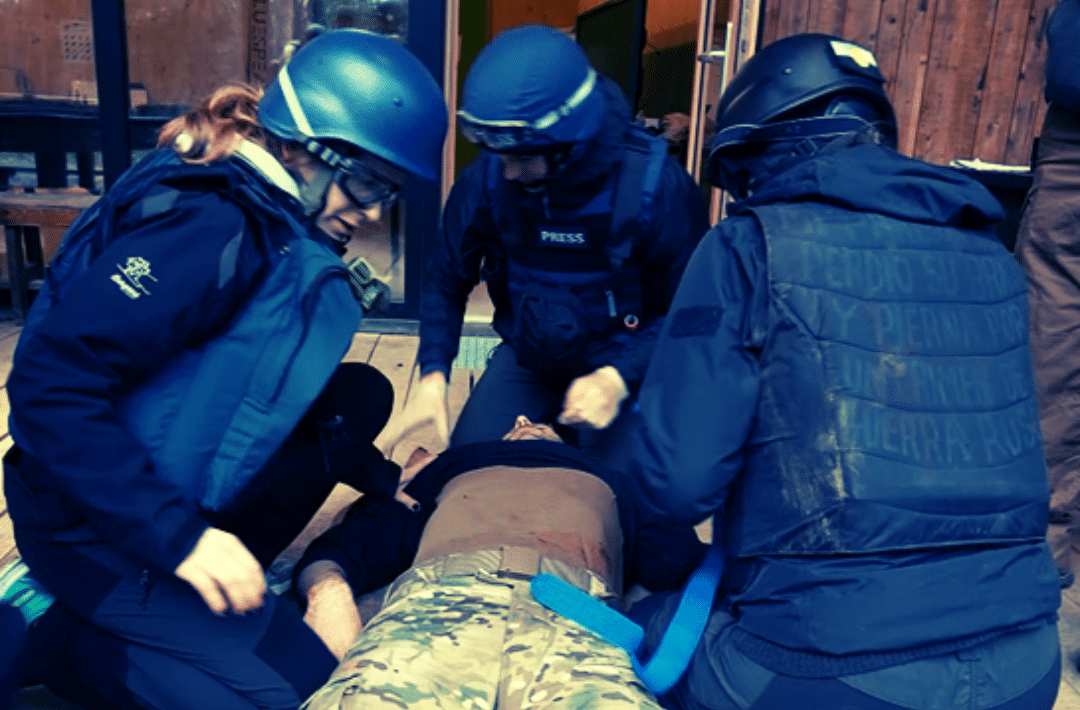
Medical training is another core element, especially austere trauma care. In many field locations, the first minutes after an injury matter most, and professional medical support may not be immediately available. At Bluespear, we consistently find that participants arriving from field-active NGOs have gaps they didn’t know existed. In a recent cohort, fewer than a third had ever applied a tourniquet under any condition, let alone under stress, at night, with limited visibility. By the end of day two, every participant could work through a basic trauma sequence with the medical kit they actually carry in the field. The gap between knowing the theory and performing under pressure is exactly what scenario-based medical training is designed to close.
Courses should also cover weapons and explosives awareness, not to build technical expertise, but to help personnel recognize threats, maintain safe distance, and respond without panic. Drone awareness now sits in the same category. We began integrating drone threat modules into our programme after participants returning from deployments in Ukraine described encounters they had no framework to process, a hovering commercial drone at a distribution point, a vehicle being tracked on a rural road. The question is never whether staff will encounter these things. In certain theatres, it is when. Training gives them a response before the moment arrives.
Civil unrest and protest response deserve focused attention, and more nuance than most courses give them. The scenario that catches aid workers off guard is rarely a full-scale riot. It is the distribution point where crowd mood shifts over 20 minutes. The checkpoint that becomes aggressive when a local official loses face. The road block that starts as a political demonstration and becomes something else by nightfall.
I know this from experience. During the 2020 coup d’état in Mali, I was working in Bamako when my local assistant contacted me early in the morning with a simple instruction: do not leave. Military factions had taken over the barracks overnight. The president had been arrested at his residence, 500 metres from where I was staying. From my window, I could see the military deployment in the street. Armed soldiers. Long rifles. Shooting that continued on and off for days. For weeks, I did not leave my accommodation. Operations moved inside. Every decision had to be made with incomplete information, no clear timeline, and no certainty about when the situation would stabilise.
What followed was not a quick recovery. International sanctions were imposed on Mali after the coup, and for almost six months I could not leave the country. There were no clean exits, no straightforward evacuation options, no clear endpoint. Just an extended period of operating inside a country that had fundamentally changed around you; managing risk, maintaining communications, and making daily judgement calls with no guarantee of how or when the situation would resolve.
That is the reality our scenarios are built around, not the dramatic moment of an incident, but the weeks and months of managed uncertainty that surround it. When to stay. When to move. How to communicate without escalating. How to keep functioning when the environment outside your door has fundamentally changed and there is no clear path out.
Kidnap and detention survival are difficult subjects, but they are part of the operating reality in some regions. Here again, the point is not to create false confidence. It is to improve survivability through understanding, discipline, and behavioral control in the early stages of an incident.
Then there is resilience, and it is consistently the module participants underestimate before the course and value most afterwards. Fatigue, cumulative stress, moral pressure, and repeated exposure to uncertainty can damage judgment long before a major incident occurs. We see it in every cohort: the participants who arrive confident and find, by day three, that sustained pressure reveals habits and reactions they did not know they had. Effective training treats resilience as operational performance, not as a soft add-on. This is the core of what hostile environment training for aid workers delivers in practice.
What to look for in a training provider
Not all courses described as HEAT are equal. For aid organizations and individual humanitarians, the quality of delivery matters as much as the syllabus.
The first test is instructor credibility. Participants should be taught by professionals with direct experience in hostile environments, not by people working from a purely theoretical model. The strongest faculty teams are cross-disciplinary. Journalists, medics, humanitarian practitioners, and security specialists each bring a different lens, and that mix tends to produce more realistic teaching.
The second test is realism. A course should create pressure without becoming theatrical. Scenarios need to be believable, structured, and tied to decisions participants are likely to face in the field. There is a difference between useful stress exposure and training that is memorable but operationally shallow.
The third test is relevance to humanitarian work. Aid personnel do not move through hostile environments in the same way as military units or close protection teams. They often depend on acceptance, local relationships, and a limited security footprint. Training should reflect those constraints rather than importing methods that do not fit the mission.
This is the standard Bluespear holds itself to. We do not teach hostile environment awareness from a manual. Our instructors have operated in the environments they teach — and that difference shows in the quality of the scenarios, the realism of the pressure, and the relevance of the feedback participants receive.
How training improves field performance
The value of HEAT is not that it removes risk. It reduces preventable mistakes and improves response quality when events go wrong. That may sound modest, but in security terms it is significant.
A trained aid worker is more likely to challenge a weak movement plan, identify an unsafe pattern, or recognize that a crowd is shifting before it becomes dangerous. They are more likely to use communications properly, maintain team discipline, and act with purpose in the first critical moments of an emergency. Those are the margins that matter.
Training also creates a common operating language. When teams share the same approach to casualty care, incident response, movement security, and escalation thresholds, coordination improves. That is valuable for both individual safety and organizational control.
There are limits, of course. A four-day course will not replicate months of field experience. It will not solve weak organizational systems, poor leadership, or flawed security culture. If a program is treated as a one-time fix, its impact will be narrower. The best results come when training sits alongside clear protocols, sound pre-deployment planning, and regular refreshers.
When aid workers should take HEAT training
Ideally, training happens before first deployment to a higher-risk environment, not after an incident or near miss. It is particularly relevant for field coordinators, program managers, assessment teams, emergency response staff, media-facing personnel, and anyone likely to travel outside low-risk urban settings.
It is also useful for experienced professionals who have operated for years without formal instruction. Informal field learning can build confidence, but it can also normalize weak habits. Structured training gives people a chance to test assumptions, update methods, and pressure-check how they respond.
For employers, timing matters. Sending staff into unstable settings with only a briefing note and a phone contact is not serious preparation. If the risk environment includes conflict, unrest, kidnapping exposure, or delayed medical support, formal HEAT should be part of deployment planning.
The standard should be readiness, not reassurance
The best hostile environment training for aid workers does not promise certainty. It teaches professionals how to function when certainty is gone. That means sharper awareness, better casualty response, more disciplined movement, and stronger judgment under stress.
For humanitarian teams, that is not a peripheral skill set. It is part of being deployable, dependable, and fit for work in places where conditions can change faster than policy can keep up. The right hostile environment training for aid workers will not make the field safe, but it can make your people far better prepared to meet it.
